Lead Qualification Questions: What to Ask Before You Quote
Lead qualification questions for small businesses in Malta: what qualifying means, BANT in plain words, and what to ask a trade, clinic or agency lead.
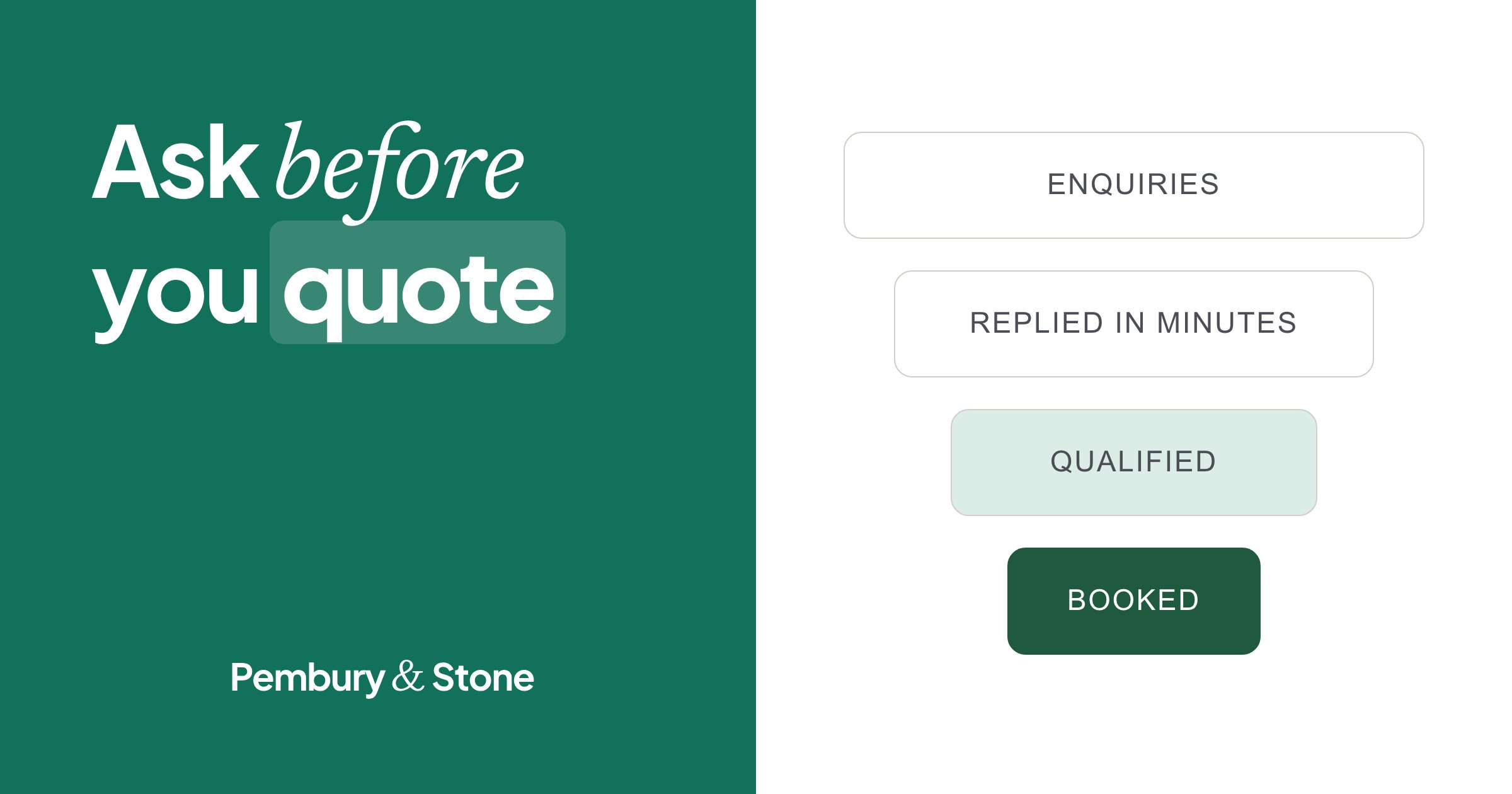
A message arrives on Thursday evening. “How much for a bathroom?” You reply, you drive over on Saturday, you measure, you spend Sunday night pricing tiles and labour. You send a tidy quote on Monday. Then you find out they were only curious, the flat is rented, and the landlord has not agreed to anything.
Nobody did anything wrong. But nobody asked the right questions first. This guide covers the lead qualification questions that save an owner those Saturdays: what qualifying a lead means, why it belongs before the quote, the classic frameworks such as BANT in plain words, a ready list of questions for a trade, a clinic and an agency, how to ask about budget in Malta without sounding pushy, and what to do with the leads that are not ready yet.
What is lead qualification?
Lead qualification is deciding whether an enquiry is worth your time, and how much of it, before you spend that time. In practice it is a short conversation. You ask a handful of questions, and the answers tell you one of three things: this is a real job you want, this is a real job but not yet, or this is not for you.
A qualified lead is not the same as a keen lead. Some of the warmest people on the phone have no budget, no date and no say in the decision. Some of the quietest have all three. Qualifying swaps your gut feeling for a few plain facts.
It is not a test for the customer. Done well, it feels like good service, and the quote that follows fits what they asked for.
A quote is the answer. Qualifying is making sure you heard the question.
Why qualify a lead before you quote?
For a big company, qualification is about where to point a sales team. For an owner-run business, it is about the owner's evenings.
A quote is expensive to make
A proper quote can mean a site visit, measurements, supplier prices, a drawing, or an hour in a clinic chair. All of it is unpaid. Every quote you send to someone who was never going to buy is time taken from someone who was.
In Malta, that time usually belongs to the person who does the work. Of the 60,856 active enterprises the NSO counted in 2024, 73.2% were sole traders and partnerships (NSO, Business Demography 2024). Construction alone made up 9.9% of them, and professional, scientific and technical services 15.3%. These are businesses where quoting happens after hours, by the person who will turn up on the day.
Qualify fast, while the lead is warm
Qualifying is also a race against the clock. When researchers sent test enquiries to 2,241 US companies, firms that tried to reach a lead within an hour were nearly seven times as likely to qualify it as firms that waited longer (Harvard Business Review, 2011). An earlier study by the same lead researcher, of more than 15,000 leads, found the odds of qualifying a lead were 21 times higher when it was called within five minutes rather than after thirty (Lead Response Management study, 2007, summarised by Expertise.ai).
So the questions are not something to save for the site visit. Ask them in the first reply, on the same channel the customer used, while they still remember why they got in touch.
BANT for small business: the frameworks in plain words
Sales books are full of acronyms for qualifying a lead. Most are built for firms selling to large companies. A few ideas are worth stealing.
BANT: budget, authority, need, timing
BANT is the oldest and best known. It asks four things. Can they pay for it? Are they the person who decides? Do they have a problem you solve? When do they want it?
It is almost always credited to IBM, often “in the 1950s” or “the 1960s”, but we could not find the original IBM document, and the dates in sales blogs do not agree. What we could find is IBM using it. A 2012 IBM form for its partners asked them to register only opportunities where they had made at least one sales call and knew “the customer's Budget, Authority, Need and Timeframe” (IBM PartnerWorld, BANT criteria template, 2012). The same form says purchasing staff do not count as decision makers. That is a useful reminder for any business: the person who asks is not always the person who decides.
MEDDIC and SPIN: built for bigger sales
MEDDIC was created in 1996 by Dick Dunkel and Jack Napoli at the software company PTC, and later written up in a book with Andy Whyte (MEDDICC, 2020). It adds things like the buyer's decision process and an inside champion. That is right for a six-month deal with a committee. It is too much for a kitchen.
SPIN comes from research rather than a single company. Neil Rackham's team at Huthwaite studied more than 35,000 sales calls for the work behind SPIN Selling (1988), and its lesson is about questions: good sellers ask about the customer's problem and what that problem is costing them, before they talk about themselves (Huthwaite International). That lesson travels well to any small business.
What a small business should keep: five things
Strip the frameworks back and five questions are left. If you know these five, you know whether to quote.
- The problem. What do they want done, and why now? This is SPIN's lesson and BANT's need.
- Fit. Is it work you do, in an area you cover, at a size that suits you?
- Timing. When do they want it, and is there a real date behind it, such as a move, an opening or a season?
- Who decides. Is it them, a partner, a landlord, a board?
- Budget. Have they a figure or a range in mind, and does it roughly match what the job costs?
Lead qualification questions to ask, by business type
Here are qualifying questions for sales in three kinds of business. Do not read them out like a form. Pick four or five, in your own words, and ask the rest only if the job needs them. Start with the problem and end with budget, once the customer has had a chance to explain.
Qualifying questions for a trade
For builders, tilers, electricians, plumbers, solar and AC installers. Our page on trades in Malta shows how we handle these enquiries.
- “What would you like done, and what made you decide to do it now?”
- “Where is the property, and how is the access? Which floor, is there a lift, can a van park nearby?”
- “Is it your own place, or are you renting?” (A tenant usually needs the landlord's yes.)
- “When would you like it finished by? Is there a date driving that, like a move or a family event?”
- “Could you send a few photos and rough measurements?”
- “Have you chosen materials, or would you like us to suggest some?”
- “Are you getting other quotes?” Asked plainly, it is a fair question and most people answer it honestly.
Qualifying questions for a clinic
For physiotherapists, dentists, aesthetics and private practices. Keep the questions about the appointment, not the medical history. Health data is a special category under the GDPR (Article 9, Regulation (EU) 2016/679); it belongs in the patient record, not a sales list. More on this in our page for clinics in Malta.
- “What would you like to book in for?” In general terms only.
- “Is this your first visit with us, or have you been before?”
- “Were you referred by a doctor, or did you find us yourself?”
- “Will you be paying yourself, or claiming on insurance?”
- “Which days and times suit you best, and which clinic is closer?”
Qualifying questions for an agency or B2B service
For marketing agencies, accountants, IT firms, consultants and suppliers to other businesses. Here, who decides and what it is costing them matter most.
- “What is the problem you are trying to fix, and what is it costing you today?”
- “What have you tried already, and why did it not work?”
- “Who else will be involved in choosing, and how will you decide?”
- “When do you need to see a result, and what happens if you do not?”
- “Is there a budget set aside for this, or are you still working one out?”
How to ask about budget without sounding pushy
Budget is the question owners skip. It feels rude, especially in a small country where the customer may be a cousin of your neighbour. But skipping it does not make the money question go away. It moves it to the end, after you have done the work.
A few ways to ask that feel natural:
Do you have a figure in mind, or would it help if I gave you a rough range first?
- Give a range first. “Most bathrooms like yours come in somewhere between a basic refit and a full redo. Which end are you thinking?” People find it easier to point than to name a number.
- Offer options. “I can price it two ways: the essentials, or with the extras you mentioned. Would both be useful?”
- Ask about a ceiling, not a figure. “Is there an amount you would like to stay under?”
- Explain why you are asking. “I ask so I don't send you something that misses the mark.” Said plainly, this is the line that takes the edge off.
- Accept “I don't know”. Then ask how they will decide, and quote in a way that makes the choice easy.
Red flags, green flags, and what to do with each
No single answer rules a lead in or out. Look for the pattern across the five questions.
- Green: they describe the problem in their own words, and there is a reason it matters now.
- Green: there is a date behind the timing, such as a move, an opening or a season.
- Green: they answer the budget question, even with a wide range.
- Green: they send the photos, the plan or the brief when you ask.
- Red: “Just give me a ballpark” and nothing else, again and again.
- Red: nobody they name has the final say, and they will not bring that person in.
- Red: no date at all, and no reason for one.
- Red: the job is far outside your area or your usual size, and you would be stretching to do it.
Not ready yet: park it with a date
A lead with a real need but no timing is not a lost lead. It is a lead for later. Agree a month with them, write the date down, and call when it comes. “You said after the summer. Shall I ring you in the first week of September?” Most people say yes, and are pleased when you actually do.
Parked leads are some of the cheapest sales you will make, because the first conversation has already happened. Calling them back with a reason, at the right time, is the same habit as customer reactivation.
Not before the summer. Call me in May.
Not a fit: refer on, politely
Some jobs are too small, too big, too far or simply not what you do. Say so early and kindly, and name someone who does it if you can. In Malta, people remember who helped them. “This isn't one for us, but you could try…” costs nothing and protects your name.
How qualification shows on your pipeline and Monday report
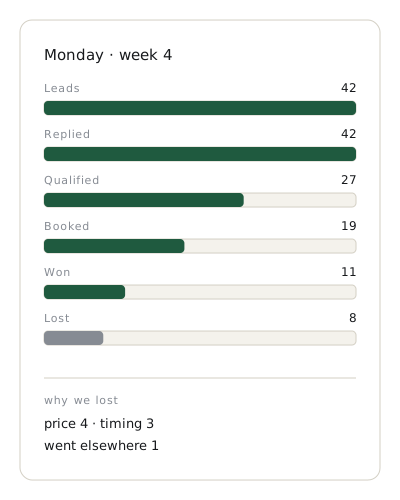
Qualifying is a stage, not a feeling. In what is a sales pipeline we set out six stages; qualified is the third. A lead moves into it only when you know the problem, the fit, the timing, who decides and, roughly, the budget. Write the five answers next to the name. Then every lead has a status anyone can read: qualified and quoting, parked until a date, or closed as not a fit with the reason.
Then count it. Once a week, write down leads in, qualified, quoted and won. The gap between leads in and qualified tells you about your marketing. The gap between quoted and won tells you about your quotes and your follow-up. We call that page the Monday Number; the free Monday Number template has the columns ready.
Common lead qualification mistakes
Most of these come from being busy, not careless. A short, written routine fixes most of them.
- Quoting first, asking later. The visit happens before a single question is asked.
- Treating qualifying as an interrogation. Ten questions in a row, read off a list. Four good ones in a conversation work better.
- Leaving budget to the end. By then you have done the work.
- Talking only to the person who called. If a partner or landlord decides, find a way to include them before the quote, not after.
- Dropping the “not yet” leads. No date, no call, and the work goes to whoever rang back.
- Never writing the answers down. If the answers live in your head, nobody else can pick the lead up, and you forget them by Friday.
- Qualifying, quoting, then going quiet. A qualified lead still needs chasing. Our guide on how to follow up on a quote has a four-touch plan.
Do it yourself, or hand it to a sales desk
If you answer your own enquiries, start with the five questions this week. Ask them in the first reply, before you book a visit, and write the answers next to each name. Within a month you will have fewer quotes, better ones, and more evenings back. If you want to see what the unanswered ones are costing, try the lost enquiry calculator.
If you do not have time to answer every enquiry within the hour, that is the work our desk does. We reply on every channel in your name, ask your qualifying questions, park the not-yet leads with a date, book the real ones into your diary and send you the Monday Number. We always say who we call for. No AI voice on any call that sells. One “stop” ends it. We call between nine and one and between four and seven, never on a Sunday, and we take one business per trade, per town. See how sales pipeline management works.
Either way, ask before you quote. If you would like someone to ask for you, talk to our sales team.
Questions owners ask
What is lead qualification in simple terms?+
It is checking, with a few short questions, whether an enquiry is a real job you want before you spend time on a quote. You find out the problem, whether it fits your business, the timing, who decides and the rough budget. The answer is yes, not yet, or not for us.
What are the best lead qualification questions?+
Five cover most small businesses. What do you want done, and why now? Is it in our area and line of work? When do you need it by? Who else is involved in deciding? Have you a figure or range in mind? Ask them in your own words, problem first and budget last.
Is BANT still useful for a small business?+
Yes, as a checklist rather than a script. Budget, authority, need and timing are all worth knowing before you quote. Add fit, meaning whether the job suits your skills, area and size, and lead with the customer's problem rather than their budget.
How do I ask about budget without being rude?+
Explain why you ask, then offer a range or two options for the customer to point at. Ask whether there is an amount they would like to stay under, instead of asking for a figure. If they do not know, ask how they will decide.
What should I do with a lead that is not ready to buy?+
Agree a month to come back, write the date down and call when it comes. A lead with a real need and no timing is a lead for later, not a lost one. Keep it on your pipeline as parked, with the date.
How many questions should I ask to qualify a lead?+
Four or five in the first conversation is usually enough. Ask more only if the job needs them, such as access details for a trade. A long list read out like a form puts people off.
- The Short Life of Online Sales Leads (Oldroyd, McElheran and Elkington), Harvard Business Review (2011).
- Speed-to-Lead Statistics, Verified, With Folklore Debunked (Lead Response Management study, 2007), Expertise.ai.
- BANT for Value Advantage Plus for Government Sales Opportunities: BANT Criteria Template v1.1, IBM PartnerWorld (2012).
- Who Created MEDDIC? The History Behind the Framework, MEDDICC.
- The SPIN Methodology, Huthwaite International.
- Business Demography: 2024 (NR 218/2025), National Statistics Office Malta (2025).
- Regulation (EU) 2016/679 (GDPR), Article 9, EUR-Lex (2016).
- BlogWhatsApp Business for Sales: A Practical Guide for Malta
- BlogWhat Is a Sales Pipeline? A Plain Guide for Small Businesses in Malta
- ServiceSales pipeline management: every lead worked until it closes
- ServiceThe sales front for trades in Malta
- ServiceThe sales front for clinics in Malta
- ServiceLead follow-up: every quote chased until there is an answer