How to Reduce No-Shows: A Guide for Clinics in Malta
How to reduce no-shows at your clinic: what the research says about reminders, timing, waiting lists and no-show policies, with message examples.
Ten o’clock on a Tuesday. The chair is ready, the room is clean, the notes are open. The patient does not come. No call, no message. Forty minutes of the day go quiet, and someone on your waiting list would have taken them gladly.
Every clinic in Malta knows this hour. This guide shows how to reduce no-shows with what the research supports: why patients miss appointments, which reminders work and when to send them, how to refill a cancelled slot, how to write a fair no-show policy, and what Malta’s privacy rules mean for a reminder text. It is written for dental, physio, aesthetic, veterinary, GP and specialist clinics. The same steps fit a salon or a trade with booked visits.
What a no-show really costs a small clinic
A no-show is not only a gap in the diary. It is a clinician waiting, a room prepared for nobody, and a patient who needed that slot sent to next week. Researchers who reviewed the evidence list the same costs: lost productivity, unused staff time and equipment, and longer waits for the patients who do turn up (Dantas et al., Health Policy, 2018).
The size of the problem is well measured. Across 105 studies, the average no-show rate was 23.0%. Studies from Europe averaged 19.3% (same review). In Malta, studies at Mater Dei Hospital found that 20% of scheduled outpatient appointments in five specialities were missed in 2016. A later audit of a surgical outpatients clinic counted 49 missed appointments out of 227, a rate of 22% (Attard, Grech and Caruana Dingli, Malta Medical Journal, 2019_-_A2.pdf)).
Those are public hospital figures, and a private clinic with its own patients is usually better. But in a small clinic, one empty slot a day is a whole working day lost every week or two. It pays to know your own number, and to work on it.

Why patients miss appointments
Most no-shows are not rudeness. A review of 26 studies of missed GP appointments found a mean rate of 15.2%. The reasons patients gave most often were work or family and childcare commitments, forgetting, and trouble getting there (Parsons, Bryce and Atherton, BJGP, 2021).
The Malta audit called the patients who missed. Of the 41 it reached, nine did not know about the appointment at all, five forgot it, and seven knew but could not come and told nobody. Nineteen said they had not received the reminder text.
Two things predict a no-show better than anything else. The first is lead time: the longer between booking and the visit, the more likely the patient misses it. The second is history: a patient who missed before is the patient most likely to miss again (Dantas et al., 2018). Both are things a clinic can act on.
I completely forgot. Is there anything later this week?
How to reduce no-shows: what the evidence says
Five things have good evidence behind them. None of them is expensive. Most of them are about making the appointment easy to remember and easy to move.
Send appointment reminders
A Cochrane review of randomised trials found that text reminders raised attendance from 67.8% with no reminder to 78.6%. Phone call reminders reached 80.3%, a similar effect, and texts cost less per attendance (Gurol-Urganci et al., Cochrane, 2013). A later meta-analysis of 21 studies found that patients sent text notifications no-showed 15% of the time, against 21% with no notification (Robotham et al., BMJ Open, 2016).
If you do only one thing, send a reminder to every patient, every time.
Send two reminders, not one
The same meta-analysis found several notifications worked better than a single one. A trial of 54,066 primary care patients tested the timing directly. With a reminder three days before and one the day before, 4.4% missed their visit. With only the three-day reminder, 5.8% did. With only the day-before reminder, 5.3% did. Patient satisfaction did not drop with the extra message (Steiner et al., AJMC, 2018).
A sound pattern for most clinics: a confirmation when the appointment is booked, a reminder two or three days before, and a short confirmation the day before. Mater Dei’s system texts ten days and two days before.
Book sooner where you can
In one ophthalmology clinic, patients booked up to two weeks ahead no-showed 9.1% of the time. Booked six months ahead, 38.3% did (McMullen and Netland, Clinical Ophthalmology, 2015). Not every clinic can shorten its wait. But a recall booked months ahead needs a fresh confirmation nearer the date, not just a card in a drawer.
Make moving an appointment easy
Seven of the patients in the Malta audit knew they could not come and told nobody. A reminder that asks for a reply, “1 to confirm, 2 to move it”, turns some of those silences into a cancellation. A cancelled slot can be refilled. A no-show cannot.
Let the patient say it back
Two GP practices in Bedfordshire asked patients to repeat the date and time back before ending the call, and missed appointments fell 3.5% the next month. When nurses asked patients to write their next appointment on the card themselves, missed appointments fell 18% against the previous six months (Martin, Bassi and Dunbar-Rees, JRSM, 2012). These were before-and-after comparisons, not trials. They cost nothing to try.
Confirm the day before, and refill the slot
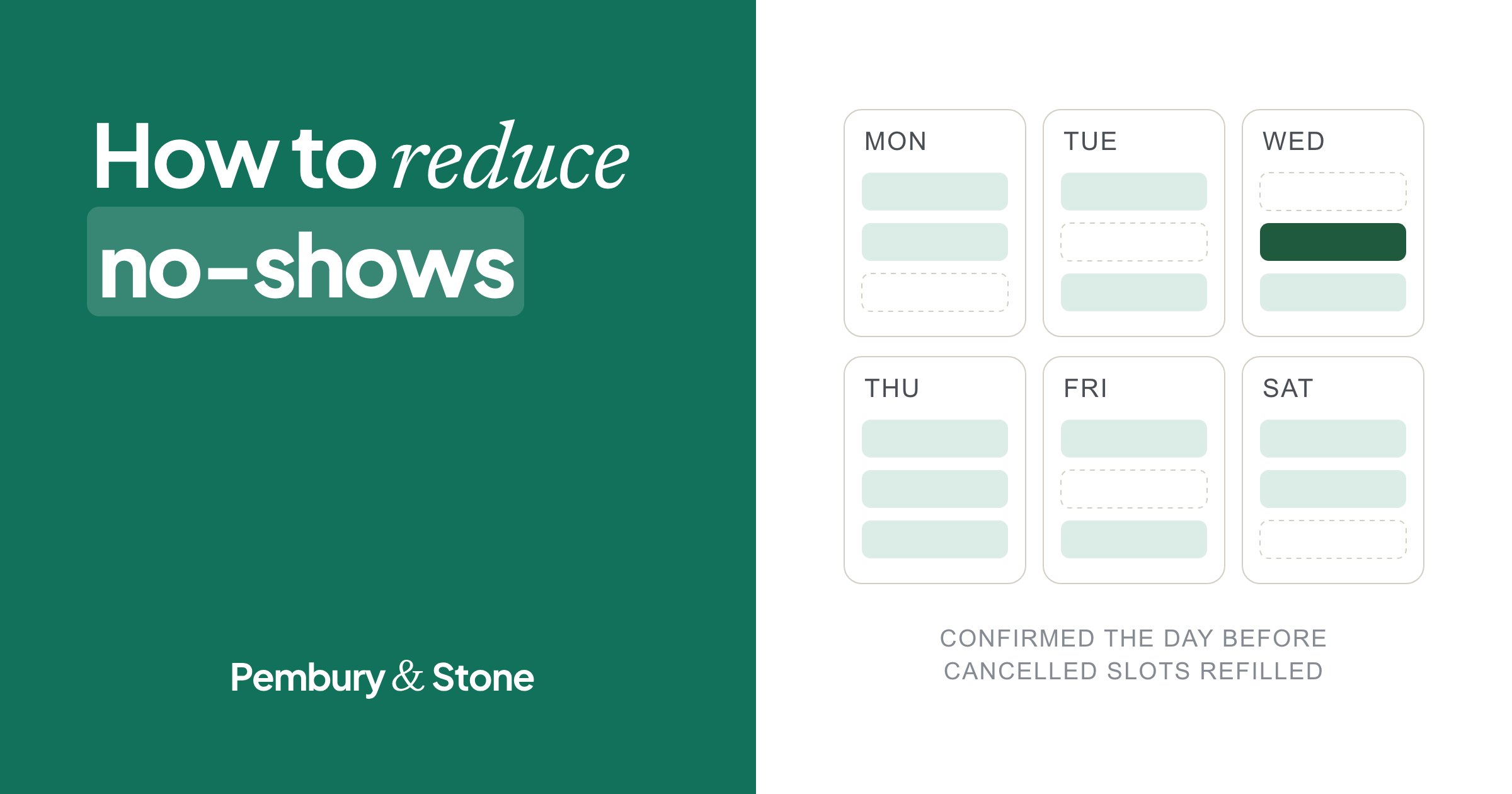
The day-before confirmation does two jobs. It reminds the patient. And it tells you, a day early, which slots are about to open. That is when a waiting list earns its keep.
Keep a short list of patients who want to come sooner: someone in pain, a dog due a check, a patient who said “any morning is fine”. When a slot opens, call them in order. A message is fine for the reminder. For refilling a slot at short notice, a phone call from a person works best, because the patient can say yes on the spot.
This is how our appointment setting desk works: book into your real diary, confirm the day before, and offer a cancelled slot to the next person on the list.
Appointment reminder examples: what to say
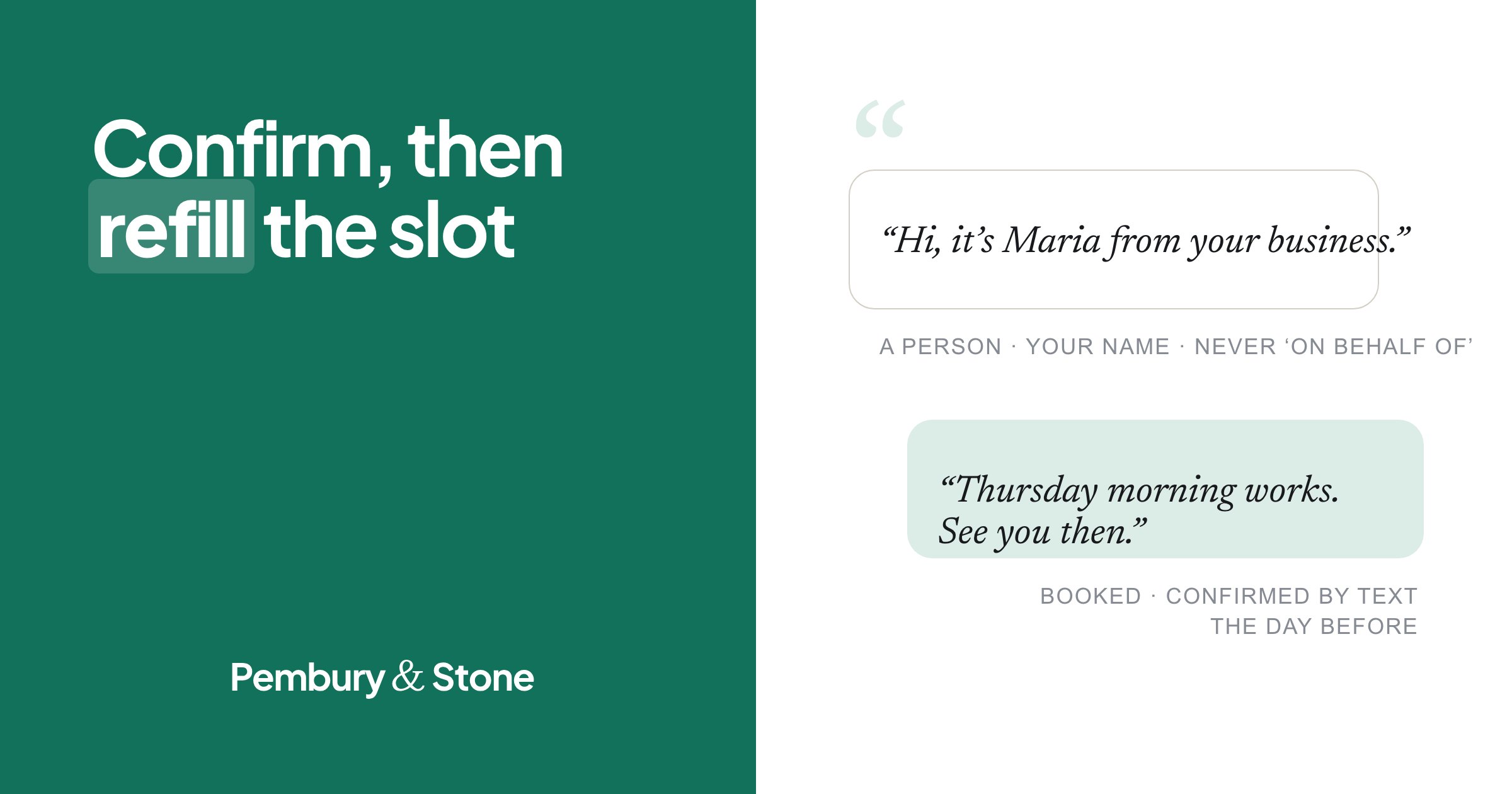
A good reminder answers four questions: who is it from, when is it, where is it, and how do I move it. Nothing else. Keep the clinic’s name first, so the patient knows it is not spam.
Wording matters, but not always the way you would guess. In two trials at a London hospital trust, telling patients the cost of a missed appointment to the health service cut missed appointments from 11.1% to 8.4%. A line about other patients waiting did less well than the specific cost (Hallsworth et al., PLOS ONE, 2015). A private clinic has no public cost to quote, and a price in a reminder sounds like a threat. The lesson that travels is this: be specific and plain, not vague and pleading.
Here are examples you can adapt for text or WhatsApp:
Who, when, where, and how to move it. A reminder needs nothing else.
- When booked: “Hi Maria, it’s [Your clinic]. You’re booked for Thursday 14 November at 10am, at [address]. To move it, just reply here.”
- Three days before: “Hi Maria, a reminder from [Your clinic]: Thursday at 10am. Reply 1 to confirm or 2 if you need a different time.”
- The day before: “Hi Maria, it’s [Your clinic]. See you tomorrow, Thursday, at 10am. If something has come up, reply and we’ll find another slot.”
- After a no-show: “Hi Maria, we missed you today at [Your clinic]. We hope all is well. Would you like us to find you another time?”
![Quote card: “Hi Maria, it’s [Your clinic]. See you Thursday at 10. Reply 1 to confirm or 2 to move it.” A day-before reminder.](/blog/reduce-no-shows/hi-maria-its-your-clinic-see-you-thursday-at-10-reply-1-to.jpg)
Get the tone right
Warm and short. No capitals, no warnings, no “failure to attend will result in…”. The Bedfordshire practices also took down waiting-room posters that counted how many patients missed, and put up the far larger number who came. Missed appointments fell further. Telling people that many others miss can make missing seem normal (Martin et al., 2012).
Writing a fair no-show policy
Many clinics ask for a deposit for long or costly treatments, or charge for late cancellations. The evidence for these is thinner than for reminders. A 2023 review of 61 studies on nudging patients to attend found 56 of them tested reminders, and little evidence on anything else (Werner et al., BMC Health Services Research, 2023).
There is also a known risk. When day-care centres in Israel began fining parents who collected their children late, late pick-ups went up, and stayed up after the fine was removed (Gneezy and Rustichini, Journal of Legal Studies, 2000). A fee can feel like a price for skipping, rather than a promise kept.
If you use a policy, make it fair and clear:
The slot is yours. If you can’t make it, tell us, and we’ll give it to someone who is waiting.
- Say it at booking, and in writing. In the confirmation, not only on a sign at reception.
- Give a reasonable notice window, and say how to cancel within it.
- Use it for the slots that hurt most: long treatments, surgery time, first consultations.
- Allow for real life. Illness and emergencies happen. A first miss can be a conversation, not a charge.
- Apply it to everyone the same way, and keep a note of why you waived it.
Appointment reminders, consent and privacy in Malta
An appointment reminder is a service message, not marketing. Malta’s rules on electronic marketing need prior consent for marketing by text or email (S.L. 586.01, regulation 9). A reminder about a visit the patient booked is not marketing. The UK regulator’s guidance, built on the same EU rules, says so plainly, and adds a warning: put an offer in a service message and the whole message counts as marketing (ICO). So keep reminders free of promotions.
Health data needs more care. Under GDPR Article 9, data concerning health is a special category, processed for health care under strict conditions (GDPR, Art. 9). Recital 35 says it includes information collected when a person registers for or receives health care. Even the fact of an appointment at a clinic can say something about a patient’s health.
In practice, for every reminder:
- No clinical detail. “Your appointment”, never the treatment, the test or the condition. Phones are read by partners and children.
- Use the number the patient gave for this purpose, and note it in their file.
- Keep reminders and offers apart. Marketing needs its own consent, and one “stop” ends it.
- On WhatsApp, Meta’s policy needs the patient’s opt-in too. Our guide to WhatsApp Business covers the set-up.
- If someone sends reminders for you, they act as your processor under a written agreement, with data kept in the EU.
How to measure your no-show rate every week
You cannot reduce no-shows you do not count. Once a week, write down four numbers: appointments booked, no-shows, late cancellations, and cancelled slots refilled. Your no-show rate is no-shows divided by appointments booked.
Then look at the patterns. Which days? Which treatments? How far ahead were the missed visits booked? Who has missed twice? The patients with a history get a phone call the day before, not only a text. Keep it on one page, every Monday, the way we keep the Monday Number for sales.
Common mistakes that keep no-shows high
Most of these are small, and each one costs slots quietly.
- One reminder, sent once. Two work better, and the day-before one tells you what to refill.
- Reminders that cannot be answered. A no-reply number turns a cancellation into a no-show.
- Clinical detail in the text. Keep it to the time and place.
- An offer tucked into the reminder. It turns a service message into marketing.
- Assuming the text arrived. Check numbers at every visit. In the Malta audit, 19 of 41 non-attenders said they had no text.
- Overbooking instead of fixing the cause. It fills the waiting room when everyone comes.
- Shaming posters and stern wording. They make missing look normal.
Do it yourself, or hand it over
Most of this needs no new software. A reminder routine, a waiting list, a fair policy and a weekly count will reduce no-shows in most clinics within a month. Start with the day-before confirmation. It does the most.
If reception is with a patient when the phone rings, that is where we help. Our desk in Malta confirms appointments the day before, calls the waiting list when a slot opens, and books recalls, in your clinic’s name. A machine may remind. Only a person may persuade, so no AI voice on any call that sells. One “stop” ends it. Patient data stays in the EU, under a written agreement. See how it works for clinics in Malta.
Either way, Tuesday’s empty chair has a fix. Talk to our sales team if you would like us to fill it.
Questions owners ask
What is a normal no-show rate for a clinic?+
It varies widely by speciality and setting. A review of 105 studies found an average of 23.0%, and 19.3% in Europe; a review of GP appointments found a mean of 15.2%. Private clinics with regular patients usually do better. Measure your own rate weekly and work on the trend.
When should I send appointment reminders?+
Two reminders work better than one. A large trial found reminders three days before and the day before cut missed visits more than either alone. Add a confirmation when the appointment is booked.
Are text reminders as good as phone call reminders?+
For attendance, about the same. A Cochrane review found text reminders had a similar effect to phone calls and cost less. Calls are still best for patients who have missed before, and for refilling a slot at short notice.
Do I need consent to send appointment reminders in Malta?+
A reminder about an appointment the patient booked is a service message, not marketing, so the consent rules for marketing do not apply to it. Use the number the patient gave you, keep clinical detail out, and keep offers out. Marketing messages need their own consent.
Should my clinic charge for missed appointments?+
It is your choice, and the evidence is thinner than for reminders. If you do, state the policy at booking and in writing, give a fair notice window, allow for illness and emergencies, and apply it to everyone the same way.
What should an appointment reminder say?+
Who it is from, when and where the appointment is, and how to move it. Put the clinic’s name first and nothing about the treatment. For example: “Hi Maria, it’s [Your clinic]. See you Thursday at 10am. Reply 1 to confirm or 2 to move it.”
- No-shows in appointment scheduling: a systematic literature review (Dantas, Fleck, Cyrino Oliveira and Hamacher), Health Policy (2018).
- A prospective audit examining non-attendance at a surgical outpatients clinic in Mater Dei Hospital, Malta, after the introduction of a text-messaging reminder system (Attard, Grech and Caruana Dingli), Malta Medical Journal (2019).
- Which patients miss appointments with general practice and the reasons why: a systematic review (Parsons, Bryce and Atherton), British Journal of General Practice (2021).
- Mobile phone messaging reminders for attendance at healthcare appointments (Gurol-Urganci, de Jongh, Vodopivec-Jamsek, Atun and Car), Cochrane Database of Systematic Reviews (2013).
- Using digital notifications to improve attendance in clinic: systematic review and meta-analysis (Robotham, Satkunanathan, Reynolds, Stahl and Wykes), BMJ Open (2016).
- Optimizing number and timing of appointment reminders: a randomized trial (Steiner, Shainline, Dahlgren, Kroll and Xu), American Journal of Managed Care (2018).
- Lead time for appointment and the no-show rate in an ophthalmology clinic (McMullen and Netland), Clinical Ophthalmology (2015).
- Commitments, norms and custard creams: a social influence approach to reducing did not attends (Martin, Bassi and Dunbar-Rees), Journal of the Royal Society of Medicine (2012).
- Stating appointment costs in SMS reminders reduces missed hospital appointments: findings from two randomised controlled trials (Hallsworth et al.), PLOS ONE (2015).
- Behavioural economic interventions to reduce health care appointment non-attendance: a systematic review and meta-analysis (Werner et al.), BMC Health Services Research (2023).
- A Fine Is a Price (Gneezy and Rustichini), Journal of Legal Studies (2000).
- Processing of Personal Data (Electronic Communications Sector) Regulations, S.L. 586.01, Laws of Malta (2013).
- Identify direct marketing (service messages), Information Commissioner's Office (UK).
- Regulation (EU) 2016/679 (GDPR), Article 9 and Recital 35, EUR-Lex (2016).
- WhatsApp Business Messaging Policy, WhatsApp Business (Meta) (2026).
- BlogWhatsApp Business for Sales: A Practical Guide for Malta
- BlogWhat Is a Sales Pipeline? A Plain Guide for Small Businesses in Malta
- ServiceThe sales front for clinics in Malta
- ServiceAppointment setting: meetings, visits and bookings into your diary
- ServiceWhatsApp sales: your business number, answered by a person