The Monday Number: a one-page weekly sales report
A one-page weekly sales report for an owner-run business in Malta: what goes on it, a template to copy, how to read it, and what it changes.
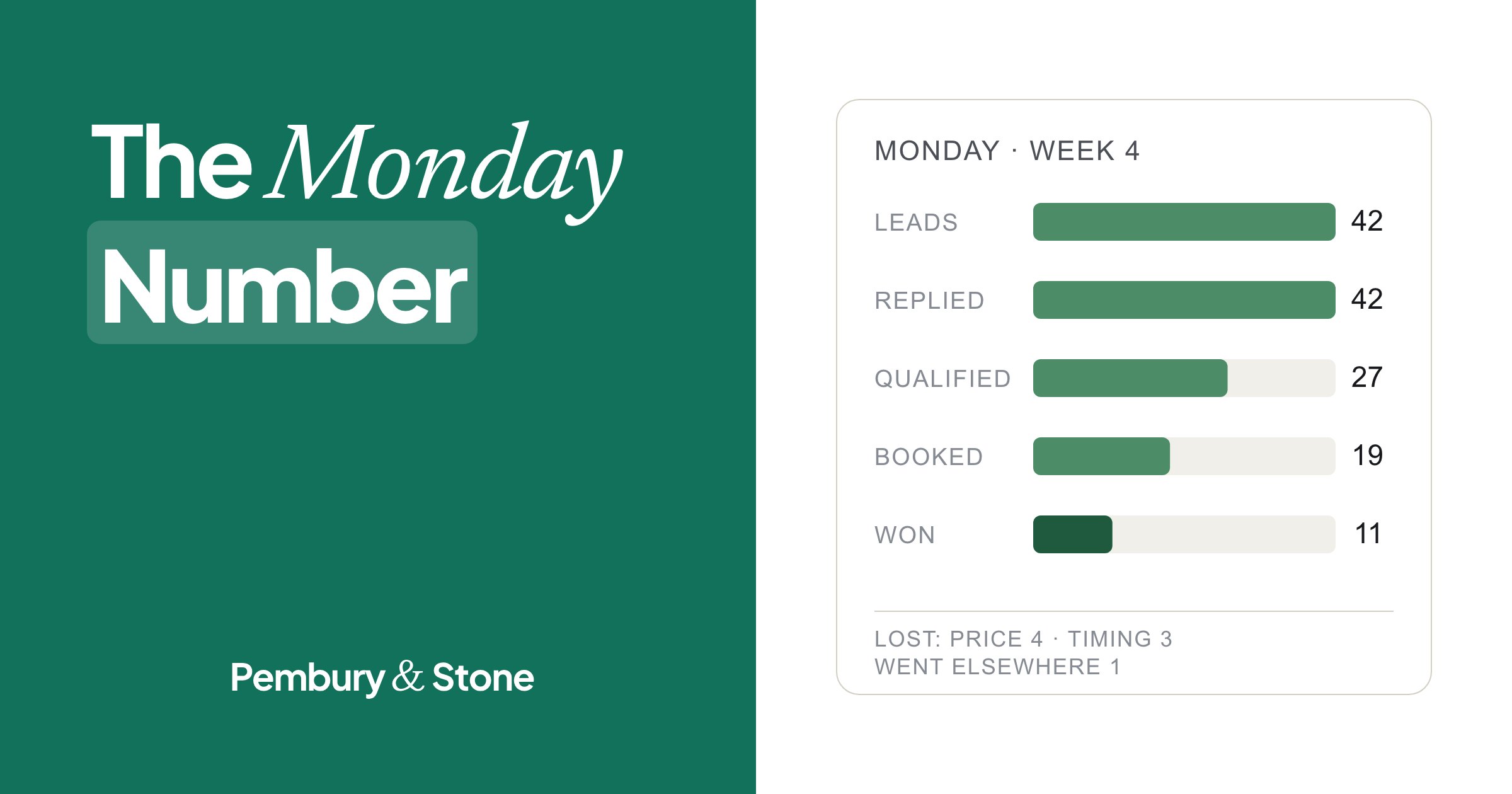
Ask a small business owner how sales went last week and you get a feeling. Good. Quiet. Busy, but nothing booked. Ask for the number and there is not one.
The Monday Number is our answer: a weekly sales report that fits on one page and takes five minutes to read. Leads in, how fast they were answered, how many were qualified, booked, won and lost, and for every lost one, the reason in the customer’s own words. This guide shows what goes on it, gives you a template to copy, explains how to read it, and walks through the decisions it leads to. Nothing here needs software. A notebook will do.
What is a weekly sales report, and why only one page?
A weekly sales report is a short record of what happened to the work that came in last week. Outcomes, not activity. How many people asked, how many you answered, how many became jobs, and why the rest did not.
Most templates you will find online are built for sales teams with managers: calls per rep, emails sent, revenue against quota, pipeline value by territory. An owner-run business needs something smaller. The person reading the report is usually the person who did the work, and they have five minutes on a Monday, not an afternoon.
So the rule is one page. If a number does not fit, it is probably not one you need. Eric Ries, who coined the phrase vanity metrics, put the test plainly: the only numbers worth collecting “are those that help them make decisions” (Ries, 2009). Every line on the page should be able to change what you do this week.

Why a weekly sales report matters for a small business
Most businesses in Malta are small and run by the person who does the work. Of the 60,856 active enterprises the NSO counted in 2024, 73.2% were sole traders and partnerships (NSO, Business Demography 2024). Nobody in those firms has “sales manager” on their card. Each enquiry is handled, or not, and then it is gone.
Writing the numbers down changes behaviour. A meta-analysis of 138 experiments, with nearly 20,000 people, found that interventions which got people to monitor their progress more often helped them reach their goals. The effect was larger when progress was physically recorded and when it was reported to someone else (Harkin and others, Psychological Bulletin, 2016). Those studies were mostly about health and personal goals, not sales. But the mechanism is the same one a Monday page uses: write it down, every week, and show it to someone.
There is sales evidence too, from bigger firms. In a survey of 62 business-to-business companies, those whose managers spent at least three hours a month reviewing each salesperson’s pipeline grew revenue 11% faster (Jordan and Kelly, Harvard Business Review, 2015). It is a survey of mostly large companies, so treat it as a pointer, not a promise. The habit of looking is what counts, not the size of the firm.
The weekly sales report template: what goes on the Monday Number
Here is the page. Copy it into a notebook, a spreadsheet or the back of an envelope. Fill it in for the seven days that ended on Sunday.
- Week of: the Monday date.
- Leads in, by channel: phone, WhatsApp, email, web form, walk-in. A count for each, and a total.
- Reply speed: the median time to first reply, and the worst case.
- Qualified: how many were real jobs you wanted.
- Booked or quoted: how many reached a visit, an appointment or a price.
- Won: how many said yes.
- Lost: how many said no, or went quiet and were closed.
- Why we lost: one line per lost lead, in the customer’s words.
- Open with no next date: how many live leads have no follow-up booked. This should be zero.
- One thing to change this week: a single sentence, written after reading the rest.
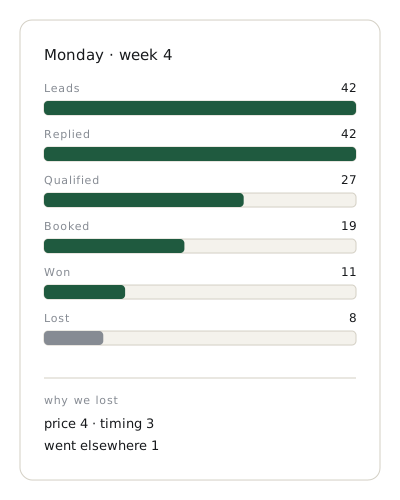
Leads in, by channel
Count every enquiry, wherever it came from. In Malta a lot of them arrive as messages: in 2025, 92% of people aged 16 to 74 used instant messaging, against 82% across the EU (Eurostat, internet activities of individuals). If you only count the web forms, you miss most of the week. The split by channel tells you where work comes from, and which channel you can least afford to leave unanswered.
Reply speed: the median and the worst case
Use the median, the middle reply of the week, not the average. One enquiry left over a long weekend can drag an average up and hide a week of quick answers. Then write the worst case next to it, because that is the customer who rang someone else.
Speed matters more than most owners think. In an audit of 2,241 US companies, firms that tried to contact a web enquiry within an hour were nearly seven times as likely to qualify it as firms that waited longer. The same audit found 23% of companies never replied at all (Oldroyd, McElheran and Elkington, Harvard Business Review, 2011). If the worst case on your page is measured in days, start there.
Qualified, booked, won, lost
These four numbers show where enquiries fall away. Many in, few qualified: the wrong people are finding you, or your adverts promise the wrong thing. Many qualified, few booked: something goes wrong between the question and the visit, often the reply or the quote. Many booked, few won: look at the price, the timing or the follow-up. If you keep a pipeline, these numbers fall straight out of it. Our guide to what a sales pipeline is explains the stages.
Lost reasons, in the customer’s own words
This is the most useful line on the page, and the one most reports leave out. For every lost lead, write one short line, in the words the customer used. “Went with someone cheaper.” “Needed it this week.” “Decided not to do it.” “Found someone closer.” Do not tidy them into categories yet. The exact words carry the detail you need later.
One reason should never appear: “Never got back to me.” That one is not about price or timing. It means the enquiry was dropped, by you. If it shows up, fix that before anything else.

Sales KPIs for a small business: the few that matter
Search for sales KPIs and you will find lists of twenty or more: customer acquisition cost, lifetime value, pipeline coverage, sales velocity. They are built for companies with a sales team and a finance team. For a business of one to ten people, most of them are noise.
The ones that matter are the ones on the template, plus two you can work out from it in your head: the share of qualified leads you won, and the share of all leads you replied to. Watch the direction, not the exact figure. A small business might see fifteen enquiries a week, so one job more or less moves the percentages a lot. Look for the same thing happening three or four weeks running.
If a number cannot change what you do on Monday, leave it off the page.
Vanity numbers to leave off
Some numbers feel good and change nothing. Leave these off the page, or at least below the line.
- Followers and likes. They do not tell you who asked for a price.
- Calls made and messages sent. Effort, not outcome. Count replies and bookings instead.
- Website visits. Count the enquiries that came from the site, not the visits.
- Revenue on its own. It arrives weeks after the work was won, so it tells you about a month ago. Keep it in the accounts, not on the Monday page.
- Pipeline value. A list of quotes, added up, looks reassuring. Most small firms win fewer than they hope, and the total hides the ones going cold.
How to read a weekly sales report in five minutes
The page only works if you read it the same way each week. With a coffee, before the first job, in this order.
- Check the worst reply time. If it is more than a working day, find out which enquiry it was and why.
- Check the open leads with no next date. Give each one a date, or close it as lost with a reason.
- Read the lost reasons in a row, then read last week’s. Look for the same words twice.
- Look at the channels. Did one grow or vanish? A web form that goes silent may be broken.
- Compare qualified, booked and won with last week. Note the stage where most fell away.
- Write one thing to change. One. Then do it before Friday.
Weekly sales report examples: the decisions it leads to
Week one, the page is small and you skim it. The value comes later, when the weeks start to line up. These examples are illustrative, built from the kind of pattern the page shows, not from a named client. The shape is real.
Needed it this week.
Week four: a pricing decision
A kitchen fitter reads four weeks of lost reasons in a row. Eight of eleven losses say “price”, and all eight were for the same service, worktop replacement. The other services lose for mixed reasons. That is not a sales problem. That is a pricing decision, and you can make it in an afternoon: reprice that one service, stop offering it, or explain on the quote why it costs what it costs.
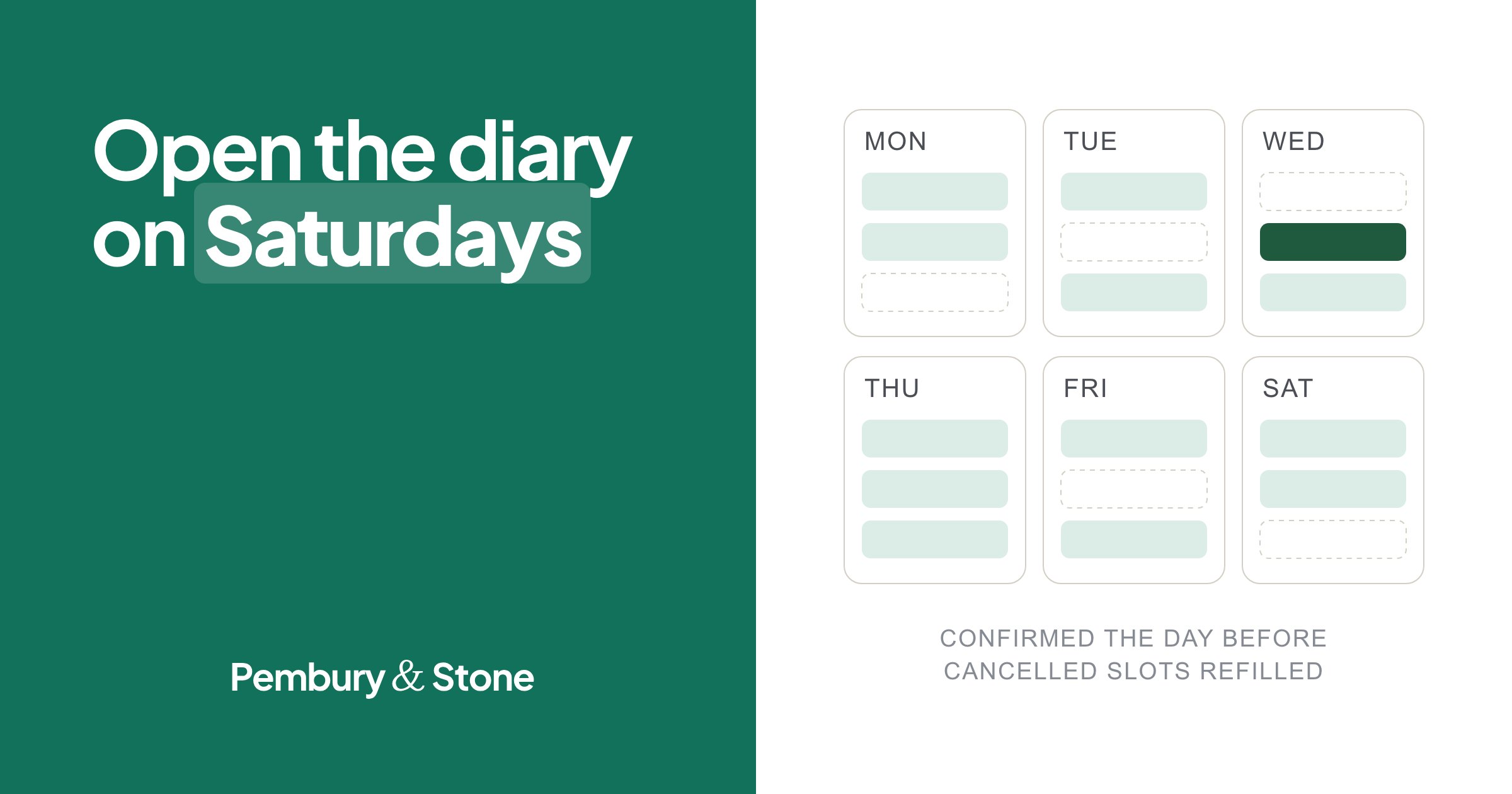
Week eight: open the diary on Saturdays
A physiotherapy clinic splits its leads by day. Saturday enquiries book at twice the rate of Tuesday ones. People message at the weekend when the pain is bad and they have time to think about it. The decision is simple: answer messages on Saturdays and offer a few Saturday morning slots.
Week six: a follow-up problem, not a price problem
A building contractor sees a lot of “decided not to do it” and “no reply” against quoted jobs. The quotes went out. Nobody chased them. That is common: in one study of about 3.5 million sales leads, half were only ever called once (Velocify data, via the National Law Review). The fix is a follow-up rhythm, not a discount. Our guide on how to follow up on a quote sets one out, day by day.
How to start your weekly sales report this Monday
You do not need a dashboard, a CRM or a consultant. You need a place to write each enquiry down as it arrives, and fifteen minutes on Monday morning the first time. After that, five.
- Pick one place for the week’s leads. A notebook by the phone, or a shared spreadsheet with one row per enquiry: date, name, channel, what they want, time of first reply, stage, next date, outcome, reason.
- Write every enquiry down within the hour. The call taken on a ladder counts. So does the WhatsApp read at a red light.
- Note the reply time when you first answer. A rough figure is fine.
- When a lead ends, write the outcome and the reason, in their words, the same day.
- On Monday, count the rows and fill in the page. Our free Monday Number template lays it out for you to print or fill in on screen.
- Keep the pages together. The fourth one is where it starts to pay.

Why weekly, not daily or monthly
Monthly is too late to fix anything. By the time you notice that quotes went unchased in the first week, the customers have hired someone else. Daily is noise: three enquiries on a Tuesday and none on a Wednesday tells you nothing. A week is long enough to see a pattern and short enough to act on it before it costs you the month. Keep the daily habit for the pipeline itself, who to call today. Keep the page for Monday.
Common weekly sales report mistakes
Most reports fail quietly. Someone fills them in for a few weeks, nobody reads them, and they stop. These are the usual reasons.
A report nobody reads on Monday is just paperwork.
- Counting only what was easy to count. If phone calls are not written down, the page shows the web form and calls it the week.
- Lost reasons in your words, not theirs. “Price” is your summary. “Found someone who could start Monday” is a timing problem dressed up as price.
- No “lost” at all. Leads that went quiet stay open forever. Close them with “no reply” after the last follow-up, so the page is honest.
- Too many numbers. Once the page runs to two, it stops being read.
- Reading it, then changing nothing. The last line, one thing to change, is the point of the other nine.
- Skipping weeks. A pattern needs a run of pages. Two missed weeks and you start again.
Do it yourself, or hand the weekly sales report over?
If you can write every enquiry down as it arrives and give the page five minutes on a Monday, run it yourself. It costs nothing, and most owners who try it learn something in the first month that they did not know about their own business.
If the enquiries arrive while you are on a job, and most of them do, the hard part is not the page. It is answering every lead, chasing every quote and writing down every outcome so the page is true. That is the work our desk does. We answer on every channel in your name, qualify and book, follow up every quote, keep every lead on a stage with a next date, and send you the Monday Number every week. See what sales pipeline management covers, or read how outsourced sales works, step by step.
A few rules we keep on every account. We always say who we call for. No AI voice on any call that sells. One “stop” ends it. We call between nine and one and between four and seven, never on a Sunday. Customer data stays in the EU. And we take one business per trade, per town.
Either way, start the page this Monday. If you would rather someone else kept the numbers true, talk to our sales team.
Questions owners ask
What should a weekly sales report include?+
For a small business: leads in by channel, reply speed as a median and a worst case, how many were qualified, booked, won and lost, and a reason for every loss in the customer’s words. Add the number of open leads with no next date, and one thing to change this week. It should fit on one page.
How do I write a weekly sales report for a small business?+
Write every enquiry down as it arrives, with the channel, the reply time and, when it ends, the outcome and the reason. On Monday, count the week’s rows and fill in a one-page template. Read it in a fixed order and write down one thing to change.
What are the most important sales KPIs for a small business?+
The ones that change what you do: leads in, reply speed, qualified, booked, won, lost and the reasons for losing. From those you can see your win rate and where enquiries fall away. Followers, calls made and website visits feel good but rarely lead to a decision.
Should a sales report be weekly or monthly?+
Weekly, for an owner-run business. Monthly is too late to save the jobs that are slipping, and daily numbers are too small to show a pattern. A week is short enough to act on and long enough to see something.
Do I need a CRM or a dashboard for a weekly sales report?+
No. A notebook or a shared spreadsheet with one row per enquiry is enough to fill in a one-page report. A CRM helps when several people handle leads, but it only reports what someone wrote into it.
Can someone produce my weekly sales report for me?+
Yes. An outsourced sales desk that answers and follows up your enquiries can record every outcome and send you the report each week. Ours sends the Monday Number to every client.
- Vanity Metrics vs. Actionable Metrics (guest post by Eric Ries), The Blog of Tim Ferriss (2009).
- Does Monitoring Goal Progress Promote Goal Attainment? A Meta-Analysis of the Experimental Evidence (Harkin, Webb, Chang, Prestwich, Conner, Kellar, Benn and Sheeran), Psychological Bulletin (2016).
- Companies with a Formal Sales Process Generate More Revenue (Jordan and Kelly), Harvard Business Review (2015).
- The Short Life of Online Sales Leads (Oldroyd, McElheran and Elkington), Harvard Business Review (2011).
- Business Demography: 2024 (NR 218/2025), National Statistics Office Malta (2025).
- Individuals: internet activities, instant messaging (isoc_ci_ac_i), Eurostat (2026).
- Study Reveals Best Contact Strategies for Optimal Lead Conversion (Velocify data), National Law Review (2016).
- BlogWhatsApp Business for Sales: A Practical Guide for Malta
- BlogWhat Is a Sales Pipeline? A Plain Guide for Small Businesses in Malta
- ServiceSales pipeline management: every lead worked until it closes
- GuideHow outsourced sales works, step by step
- ServiceLead follow-up: every quote chased until there is an answer